



Financial Impact Analysis Model for Property Tax Reform Bills
We Need Your Assistance
The League is asking city officials to download and use the 2026 Property Tax Reform Model to assess how the proposals could affect their communities. Your feedback is critical. The more real-world local data we can provide to legislators, the stronger our ability to advocate for practical, workable policy solutions.
The message the League and all cities need to communicate to lawmakers is simple:
- Let’s work together
- Cities want to be able to sustain the property tax relief delivered by the legislature
- In order to sustain that relief, cities are bringing forward proactive policy solutions that need to be incorporated into a final bill agreed to by the House and Senate.
You can find these solutions on the Cost Burden One Pager in the 2026 Legislative Advocacy Toolkit alongside in-depth explanations of the solutions.
Please run this easy-to-use model, developed by the League’s Partner, Piper Sandler & Co., as soon as possible. We encourage you to take time to review and understand your city’s results, considering both immediate impacts and longer-term implications for your budget, services and community.

The League is grateful to Piper Sandler & Co. for developing this tool and providing their expertise in support of Iowa cities. Their partnership has made it possible to deliver this resource to members at no cost.
The model is intended to inform your conversations with lawmakers. As you engage, use your results to help explain what these proposals mean for your city in practice, including how they may affect your ability to plan, budget and deliver services over time. It is important to look beyond any single-year impacts.
Rather than simply sharing model outputs, we encourage you to use this tool to develop a clear understanding of how each proposal affects your community and to communicate those impacts in your own words.
After reviewing your results, please share your key takeaways and insights with your House and Senate lawmakers, as well as with the League at legislativestaff@iowaleague.org. Please reach out with any questions.
Background
Since the beginning of session, there have been three prominent property tax reform proposals up for discussion. Last week, the House adopted an amendment incorporating several provisions from the Governor’s proposal, signaling a possible path toward compromise between those two bodies.
At this stage, HF 2745 (the House bill) and SF 2472 (the Senate bill) are the primary bills under consideration by the Iowa Legislature. While the model also includes the Governor’s proposal for comparison purposes, the House and Senate bills are the active legislative vehicles currently moving through the process.
These proposals would make significant changes to Iowa’s property tax system. Although the bills differ in structure and approach, they share similar stated goals: reforming the system and delivering property tax relief to Iowans. As negotiations continue, the Iowa League of Cities is actively engaging with lawmakers to offer targeted policy solutions that improve the legislation and help shape any final agreement.
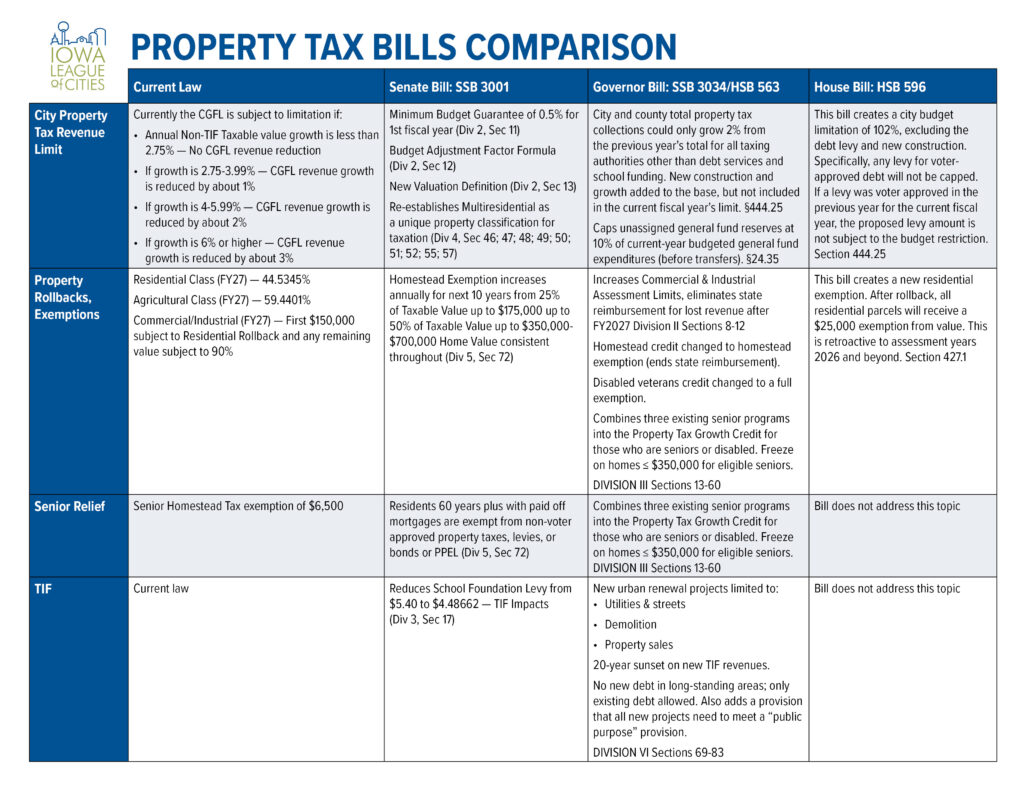
We expect additional revisions to these proposals as lawmakers continue negotiations and respond to stakeholder feedback. Your city’s information will help policymakers better understand how the current proposals could affect municipal operations, budgeting and the delivery of essential local services.
Instructions
Below are instructions to help you understand how to navigate and operate the model. To ensure a smooth process, please gather the following information before starting the model:
What You’ll Need Before You Begin:
- The Median Assessed Property Value for Residential and Commercial Classes Within Your Community
- The Average Growth Rates of Residential and Commercial Property Classes Within Your Community
A majority of this model is locked from changing inputs to allow for ease of use. With this, there are a few areas where, as you interact with the model, you will be able to customize certain inputs to best match what is occurring within your community.
- Selecting Your City: The first tab, labeled “Inputs” is where you will have the ability to select your community, or any other within the state, to be able to see the specific results of impact from the proposed property tax bills. Under Section 1 of this tab, you will be able to select from a dropdown list within the “Entity” Column. It is important to note that in addition to all cities in the state of Iowa, there is a cumulative “All Cities” input that can be selected as well. The list is in alphabetical order, but you can also begin to type the name of your community into the selection bar and it will autopopulate. After you select your community, the other tabs at the bottom of the spread sheet will be populated with customized impacts*.
- Assessed Value and Property Growth Rates: In addition to being able to select your individual city, you also have the ability to look at how the model changes over time for different property values and under different assumed growth rates. On the “Summary” tab at the bottom of the excel sheet, you will be able to adjust the assessed value of property on the lefthand side of the sheet under “Select Inputs”. Above this section, you will see set growth rates for residential and commercial properties. You have the ability to change these values from the preset assumptions if you so choose.** After you change your inputs, you will see that the charts and tables of the Summary spreadsheet will populate with different values, taking the new assumptions into account.
*It is important to note that sometimes the model “sticks” where you might need to select your city more than once in order for the graphs and data to populate correctly.
**If you would like to view historical assessed valuations for different classes of property within your community, we recommend using the Department of Management Google Drive folder here. To calculate rates of change, take the value of interest from the most recent year and a year of choice from the past (for example, 2016 for a 10-year growth rate), you will then take the value from your most recent year “x2026” and your value from 2016 “x2016” and use the following formula: (x2026 – x2016)/ x2016. In order to get a yearly growth rate average, you would then take your value from the above calculation and divide it by 10 (since you had produced a 10-year growth rate by picking 2026 and 2016 values; adjust what you divide by according to the amount of difference between the years you use for your calculations). Plug your result into the model.
How to Interpret Your Results
As you review your city’s results, consider the following:
- How do the House and Senate proposals compare in terms of overall funding impact on your city’s budget?
- Are there changes over time that could create budget pressures in future years?
- How do anticipate the effects of the proposed bills affect your ability to keep up with rising costs (wages, materials, contacts)?
- Would these changes require adjustments to service levels, staffing or capital planning?
Your observations and insights will help inform conversations with your lawmakers to better ensure they understand how these proposals translate at the local level. Again, League staff would appreciate you sharing your findings – please send an email to legislativestaff@iowaleague.org.